
Bedtime Calculator
Most adults need at least seven hours of sleep, children and teenagers more. Working backwards from your alarm is the simplest way to protect that time. This calculator suggests bedtimes for your wake-up time based on roughly 90-minute sleep cycles and the time it usually takes to fall asleep, and shows the recommended amount of sleep for each age.
- Free to use
- No sign-up
- Runs in your browser
Bedtime calculator
Sleep Routine Pack
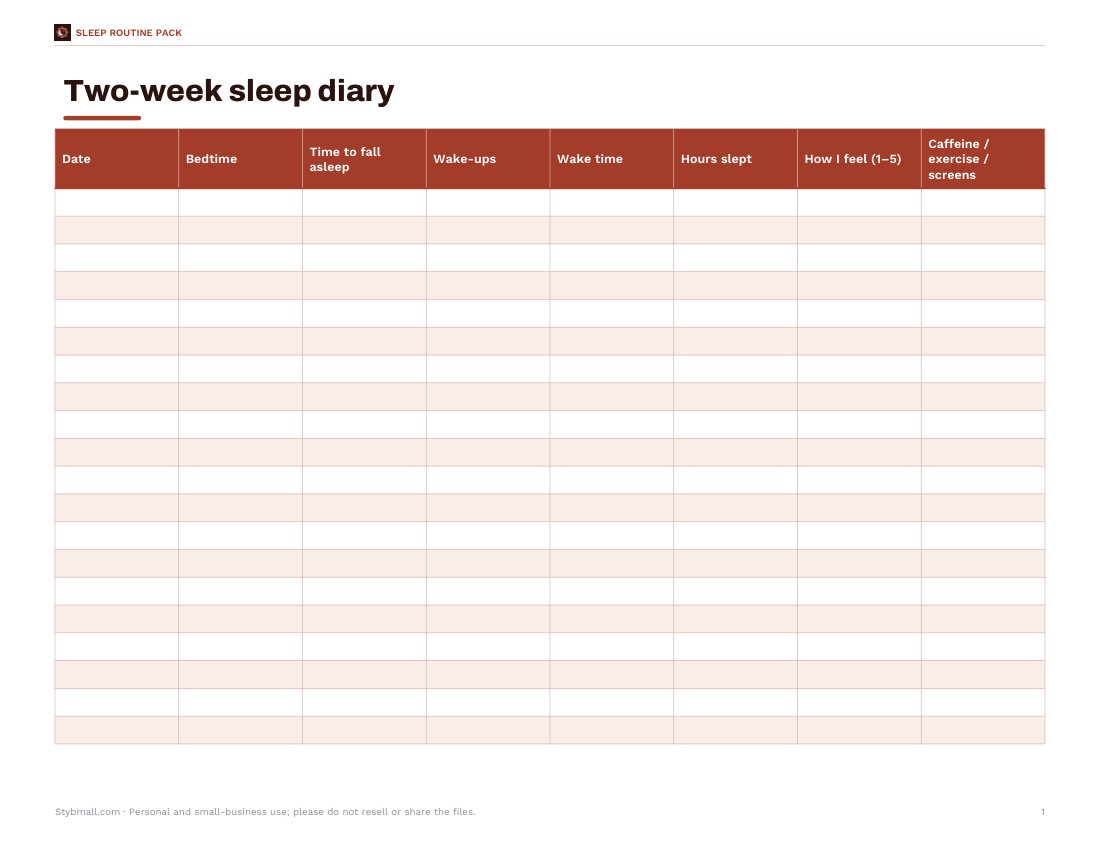
Printable two-week sleep diary, children’s bedtime routine chart, family sleep schedule planner and an Excel sleep log with averages.
- Sleep diary (PDF/DOCX/XLSX)
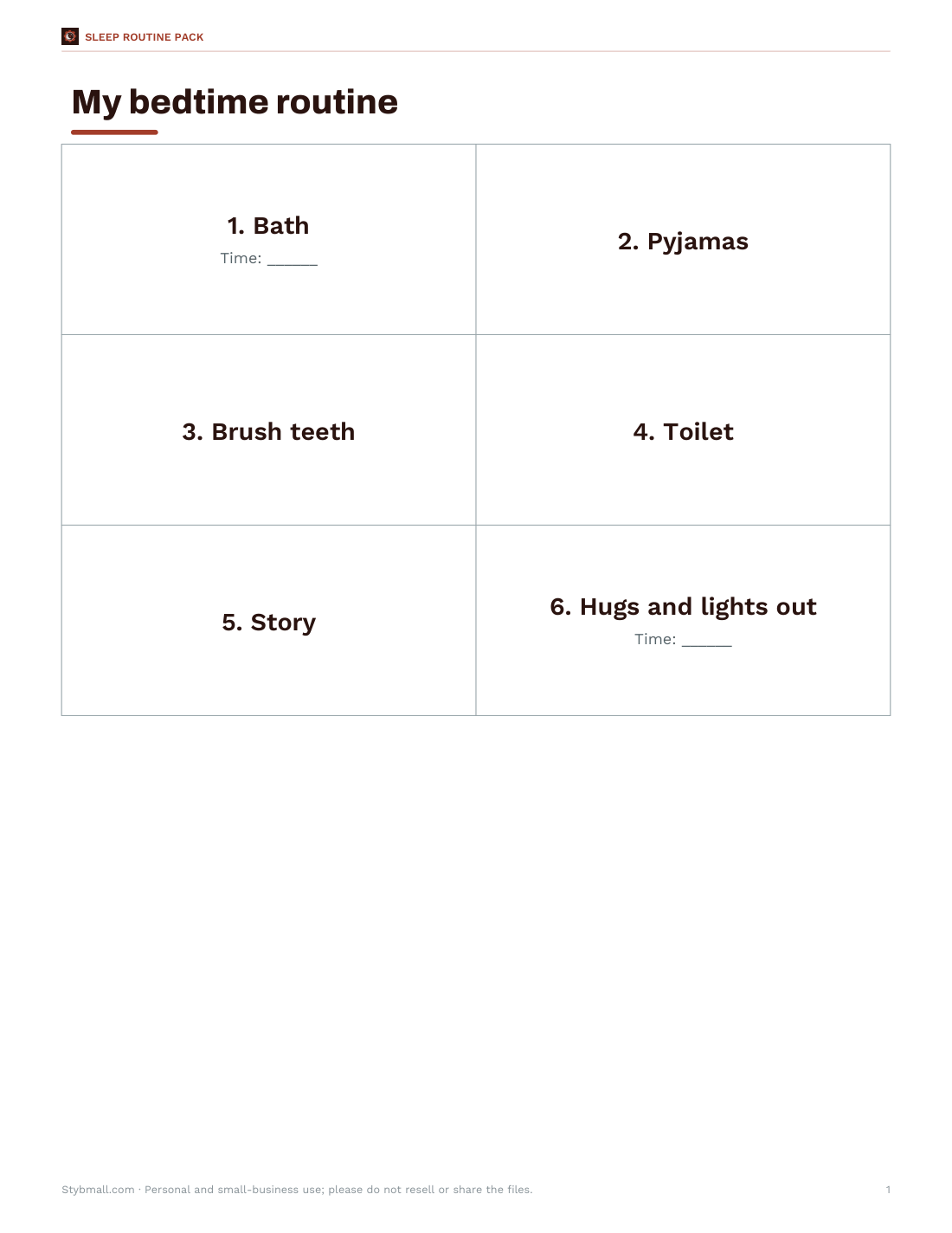
- Kids’ routine chart (PDF)
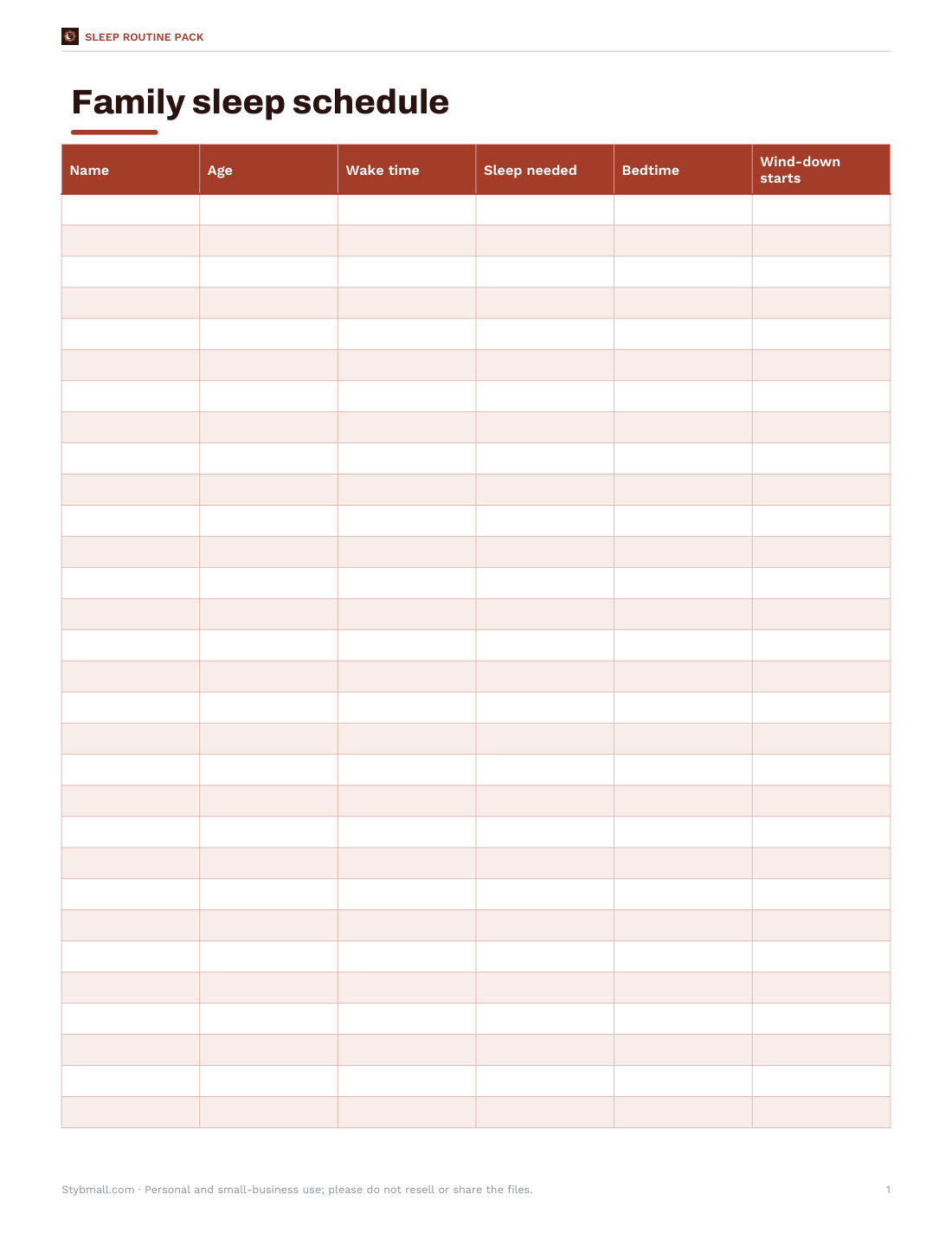
- Family schedule (PDF/DOCX/XLSX)
- Sleep log (XLSX)
Formats: PDF, DOCX, XLSX. Instant download after payment (link valid 72 hours, up to 5 downloads). AI-assisted: the templates were drafted with AI help and reviewed and laid out before publishing.
$5.00 USD, one-time 4 files · about $1.25 each
- Instant download
- 7-day refund
- Secure checkout by Stripe
7-day money-back guarantee. Full refund within 7 days of purchase, even after you download.
Free sample: Sleep Diary (PDF, 51 KB)
Full refund within 7 days — see the refund policy and license.
Free printables
Single sheets you can print right now, no sign-up. The full pack adds every sheet in one download plus the editable files.
 Printable Two-Week Sleep Diary
 Printable Kids Routine Chart
 Printable Family Sleep Schedule
 Printable Sleep Log with Averages
How much sleep do you need?
| Age | Recommended per 24 hours |
|---|---|
| Infants 4–12 months | 12–16 hours including naps |
| 1–2 years | 11–14 hours including naps |
| 3–5 years | 10–13 hours including naps |
| 6–12 years | 9–12 hours |
| 13–18 years | 8–10 hours |
| Adults 18–60 | 7 hours or more |
| Adults 61–64 | 7–9 hours |
| 65 and older | 7–8 hours |
These ranges follow widely used recommendations such as those from the American Academy of Sleep Medicine and the US CDC. Individual needs vary; if you regularly feel sleepy during the day despite enough time in bed, talk to a doctor.
Sleep cycles and the 90-minute idea
Sleep moves through repeating cycles of lighter sleep, deep sleep and REM sleep, each lasting roughly 80–110 minutes, with more deep sleep early in the night and more REM sleep towards morning. Waking at the end of a cycle, when sleep is lighter, can feel easier than being woken from deep sleep. The calculator uses 90 minutes as a convenient average; because real cycles vary, a consistent schedule and enough total sleep matter more than hitting an exact cycle boundary.
Worked example
An adult who must wake at 6:30 AM and usually takes 15 minutes to fall asleep should aim to be in bed between about 9:15 PM and 11:15 PM for 7–9 hours of sleep. The cycle-based suggestions are 9:15 PM (six cycles, 9 hours), 10:45 PM (five cycles, 7.5 hours) or, on a short night, 12:15 AM (four cycles, 6 hours) — which is below the recommended amount. For a nine-year-old waking at 7:00 AM, 9–12 hours of sleep means lights out between roughly 6:45 and 9:45 PM.
Building a bedtime routine
- Keep the same wake-up time every day, including weekends, as far as possible.
- Start winding down 30–60 minutes before bed: dim lights, put screens away.
- Keep the bedroom cool, dark and quiet.
- Avoid caffeine in the afternoon and evening, and large meals late at night.
- Get daylight in the morning, which helps set your body clock.
- If you can’t sleep after about 20 minutes, get up and do something calm until sleepy.
Children’s bedtime routines
Children often settle more easily with a predictable sequence: bath, pyjamas, teeth, a story, lights out — in the same order each night. A picture chart helps younger children follow the steps and feel in control. Screens are best switched off well before bed, and caffeine (including in some fizzy drinks and chocolate) avoided in the evening.
Shift work and jet lag
For night shifts, the same arithmetic works with a daytime “bedtime”: if you finish work at 7 AM and need to be up at 3 PM, aim to be asleep by around 7:30–8 AM, with blackout curtains and a cool room. When crossing time zones, shifting bedtime by an hour a day before travel, and getting daylight at the right time after arrival, helps the body clock adjust faster. Keep caffeine for the start of a shift rather than the end.
Morning light and a steady wake time
The body clock responds most strongly to light. Getting outdoor daylight soon after waking and keeping the same wake time every day, even after a late night, makes it easier to feel sleepy at the planned bedtime. Sleeping in for hours at weekends shifts the clock later — sometimes called social jet lag — which is why Monday mornings feel harder.
Naps
| Nap length | Effect |
|---|---|
| 10–20 minutes | Refreshing without grogginess for most adults |
| About 30–60 minutes | May cause grogginess on waking (sleep inertia) |
| About 90 minutes | A full cycle; can help after a short night but may affect night-time sleep |
Avoid long or late-afternoon naps if you have trouble falling asleep at night. Young children’s naps are part of their total sleep and are counted in the ranges above.
The sleep pack
The optional pack includes a two-week sleep diary, a printable children’s bedtime routine chart, a family sleep schedule planner and an Excel sleep log that calculates average sleep time and consistency. The calculator on this page is free.
Health note
This calculator is general information, not medical advice. Loud snoring, pauses in breathing, persistent insomnia or excessive daytime sleepiness can be signs of sleep disorders that benefit from medical assessment.
AI-assisted content
This page was drafted with AI assistance and reviewed before publishing.
Frequently asked questions
What time should I go to bed to wake up at 6 AM?
For 7.5–9 hours of sleep, around 8:45–10:15 PM, allowing about 15 minutes to fall asleep.
How long is a sleep cycle?
Roughly 90 minutes on average, varying between about 80 and 110 minutes.
How much sleep does a teenager need?
8–10 hours a night.
Is it better to sleep 6 or 7.5 hours?
Adults are generally recommended at least 7 hours; 6 hours is below that.
What bedtime for a 5-year-old?
With a 7 AM wake-up, often between about 6:30 and 8 PM to allow 10–13 hours (including any nap).
Does the calculator replace medical advice?
No — see a doctor about persistent sleep problems.
Why do I wake up tired after 8 hours?
Sleep quality, irregular timing, alcohol, caffeine or a sleep disorder can all play a part; if it persists, ask a doctor.
Should I use an alarm at weekends?
Keeping a similar wake time every day helps your body clock; a gentle alarm can help.